

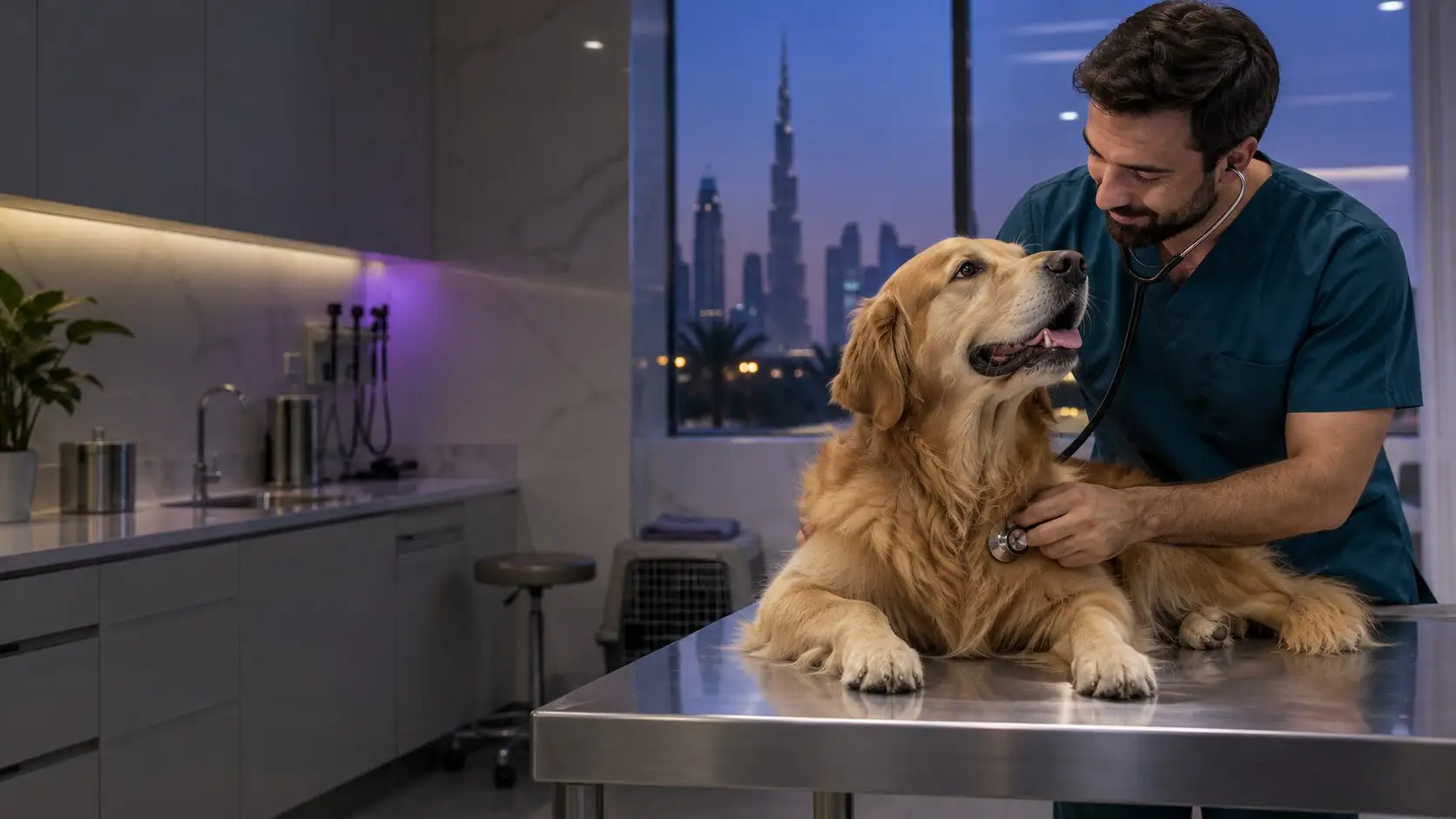
Some signs decide it for you and the rest are a phone call. Whether you need an emergency vet or wait till morning turns on breathing, bleeding, straining and consciousness, and Cornell’s Riney Canine Health Center puts the first of those beyond argument, saying any trouble breathing is an emergency.
This page sorts the signs into three groups. Call 055 620 4085, answered 24 hours, and we are open 8 AM to 12 AM every day.
What cannot wait until the morning?
These are the ones where the emergency vet or wait till morning question is already answered, because the drive starts now and the call happens from the car. Cornell lists them among its top reasons to head to the emergency vet, and each one has a reason attached rather than being a general warning.
- Breathing faster or harder than normal at rest, noisy or strained breathing, a neck stretched out to breathe, or excessive belly movement while breathing.
- Gums or tongue with a blue tinge, which Cornell names as a red flag alongside the breathing signs.
- Sudden collapse, marked weakness, or an inability to use one or more legs, which Cornell links to internal bleeding, neurologic disease or heart problems.
- A swollen belly with retching but no vomit, which Cornell says may mean bloat and can be life-threatening.
- Straining to pass urine or producing none, which Cornell says is more common in males and is very painful and potentially deadly if untreated.
- A seizure lasting more than five minutes, or several in a short time, which Cornell says needs emergency care immediately.
- A first seizure at any length, which Cornell says should always prompt a veterinary exam.
- Heatstroke signs after time in the heat, which Cornell lists as excessive panting, drooling, weakness, vomiting or collapse.
- Swelling of the face, hives or vomiting after a sting or bite, which Cornell says should be treated as a medical emergency.
- Bleeding that does not stop after five minutes of firm pressure.
- A fall from a balcony or a window, even if she gets up and walks.
- An unspayed female who is dull, drinking heavily and has discharge from the vulva, which can be a womb infection.
- A female straining hard for more than half an hour with no puppy or kitten, which Cornell lists as difficult labour needing help right away.
Trauma belongs here even when nothing shows. Cornell makes the point that internal injuries, such as after being hit by a car, might not be immediately visible, and that if your dog is in pain or has been in an accident it is safest to have them checked right away.
Read also: How do I care for my dog after surgery?
Which signs can wait till morning?
Things that are new but stable, where the animal is bright, eating and comfortable, which is where the emergency vet or wait till morning answer is the morning. The grouping below is ours rather than Cornell’s, built by taking what is not on its emergency list, and the condition attached to every line is that she stays the same overnight.
- A single episode of vomiting or a soft stool in a dog who is otherwise bright and eating.
- A limp she can still walk on, which our page on when a limp needs an x-ray sorts out.
- An itch, a small scab or a patch of fur she has been scratching for days.
- A loose nail, a small cut that has stopped bleeding, or a torn ear tip that is dry.
- Bad breath, tartar, or a tooth you have only just noticed.
- A lump you have felt for weeks that has not changed.
The deciding word in all of them is unchanged. If the limp becomes a leg she will not put down, or the one vomit becomes four, the animal has moved onto the first list rather than stayed on this one.
Watching overnight means actually checking. Look at her before you sleep and once in the night, and count her breaths while she sleeps, since under 30 a minute is normal for a resting cat or dog. A cat who has not eaten for 24 hours, or any very young, very old or diabetic animal with one of these signs, has less reserve and gets a call rather than a watch.
Emergency vet or wait till morning?
The signs in between get a phone call rather than a decision made alone at midnight. Cornell’s own advice for owners who are unsure is to call the vet or local emergency clinic, since most veterinary hospitals can offer guidance during business hours and emergency clinics are available after hours to help determine next steps.
My dog has vomited a few times tonight
Count and look. Cornell says repeated episodes of vomiting or diarrhoea in a 24-hour period, especially with blood, lethargy or refusal to eat, can signal more serious issues. A puppy in that group goes in rather than waits, because our page on parvovirus explains what else it can be.
My dog ate something, is it urgent?
Call now rather than in the morning, with the packet in your hand. Cornell puts eating a toxin or an indigestible object on its emergency list, saying that if your dog has eaten something toxic or something that could cause a blockage like a toy or a sock, you often need to act quickly, and it names chocolate, grapes and medications.
Some of them do not wait at all. Rat bait, human painkillers, chocolate in quantity, grapes or raisins, lilies for a cat, antifreeze and xylitol sweetener all belong on the first list, and our pages on rat poison and a swallowed foreign object cover what follows.
My pet’s eye is sore and half closed
Tonight, because Cornell puts eye injuries on its emergency list. It says dogs’ eyes are delicate and that squinting, redness, swelling, pawing at the eye or sudden cloudiness or discharge should be evaluated promptly to avoid more serious damage. An eye that is suddenly closed, bulging or cloudy blue is a drive rather than a wait.
Why is my cat suddenly quiet and hiding?
Check the breathing and the litter tray before you decide. A cat breathing with an open mouth is on the first list, which our page on cat open mouth breathing explains, and a male cat who has not passed urine is too.
Cornell closes its own guidance with the line we would repeat to any owner on the phone, which is to trust your instincts, because you know your dog better than anyone.
Does Dubai heat change the answer?
It moves one group of signs up, and it is why the emergency vet or wait till morning answer here is not the answer in a cooler climate. Heat turns a dog who is panting hard from a wait-and-see into something Cornell already lists as an emergency.
The signs to treat as urgent after any time outside are Cornell’s heatstroke list, which is excessive panting, drooling, weakness, vomiting or collapse, and Cornell adds that immediate cooling and veterinary care are crucial. The AVMA’s cooling instruction is room-temperature water on the neck, armpits and groin, and explicitly not a tub of cold water, which it says can make the condition worse.
Dehydration is the quieter version of the same thing. A dog who has been vomiting through a hot day loses ground faster than the same dog would in winter, which is our reasoning rather than a published figure.
So our own rule from June to September is to move a borderline case one step up. If you would normally watch until morning, phone. If you would normally phone, come in. Keep her in an air-conditioned room while you decide, and offer water.
Read also: What do I do during a dog seizure?
Is there a vet open late in Dubai?
Two things fit together, the open hours and the phone. We are open 8 AM to 12 AM every day, and the phone is answered 24 hours on 055 620 4085.
After midnight the line is triage only. The clinic itself is closed, so the nurse tells you what to do at home, and if your animal needs a vet before 8 AM she directs you to the nearest hospital that is open. We say that plainly because driving to a closed door wastes the minutes that matter.
So a sign from the first list at 10 PM is a visit here tonight, and the same sign at 2 AM is a call now and a drive to whichever hospital the nurse names. A sign from the grey zone at 2 AM is a call tonight and a slot in the morning. Either way the person on the phone settles the emergency vet or wait till morning question rather than leaving you to guess.
Until midnight you can walk in with no appointment, and an urgent case is seen ahead of routine ones. The examination comes first, and our laboratory and imaging are in the building, so bloods and pictures happen in the visit rather than being booked for another day. Fees are on the price list and you get a written estimate after the examination.
When should I call the clinic?
Whenever you are reading this page and still unsure, which is the honest answer. Describing it on the phone takes two minutes and settles the emergency vet or wait till morning question better than any list can.
- Say what changed and when, rather than what you think it is.
- Say whether she is breathing normally and what colour her gums are.
- Say whether she can stand, and whether she has eaten or passed urine.
- Have the packet with you if she ate something, and her medication if she is on any.
Our emergency page says what happens when you arrive.
Frequently asked questions
Short answers to what owners search at night when deciding between an emergency vet or wait till morning.
Can a dog’s vomiting wait until morning?
One episode in a bright dog can. Cornell says occasional vomiting or soft stool can happen, but that repeated episodes in a 24-hour period, especially with blood, lethargy or refusal to eat, can signal more serious issues, so the count and the dog’s demeanour are what decide it.
Is heavy panting at night an emergency?
Treat it as one until a vet says otherwise. Cornell’s line is that any trouble breathing is an emergency, and it lists excessive panting among the heatstroke signs needing immediate cooling and veterinary care. In a cat, open-mouth breathing at rest is never normal.
My cat cannot pee, can it wait?
No. Cornell says straining to urinate or producing no urine could mean a urinary blockage, that it is more common in males, and that it is very painful and potentially deadly if untreated. That is a drive now rather than a morning appointment.
Does a limp need an emergency visit?
Not in our view, unless she will not use the leg at all or is crying. Cornell puts obvious injuries like wounds or broken bones in the urgent group, and says signs of severe pain or distress, such as crying out, shaking or being unable to move, mean seeking attention right away. A leg she will not put down at all is the line.
Is a swollen belly in a big dog urgent?
Yes, especially with retching. Cornell says a swollen belly paired with retching but no vomit may mean bloat, which can be a life-threatening emergency, and that dogs may also appear restless or uncomfortable.