

A cat who breathes through an open mouth at rest is short of oxygen and needs a vet now. Cats do not pant the way dogs do. Put her in a carrier with as little handling as you can, cool the car, and call 055 620 4085 on the way.
The phone is answered 24 hours. The clinic is open 8 AM to 12 AM every day, and after midnight the nurse will direct you to the nearest open hospital.
Is open-mouth breathing ever normal in a cat?
Rarely, and only briefly. A young cat may pant for a minute after a hard chase. A cat may pant in the carrier on a stressful drive. In both cases the mouth closes within a few minutes once she is calm and cool.
It is not normal if it lasts more than a few minutes, if it happens at rest, or if it comes with any of the signs below. When in doubt, treat it as an emergency. A cat hides breathing trouble until she has very little reserve left.
What other signs go with it?
- Fast breathing at rest. More than 40 breaths a minute in a resting cat is abnormal. Under 30 is normal.
- The belly and chest heave with each breath.
- She crouches with elbows out and neck stretched forward, and will not lie on her side.
- Gums or tongue look blue, grey or very pale.
- Coughing, wheezing or a crackling sound.
- She hides, refuses food, and resents being picked up.
To count breaths, watch her chest while she rests. One rise and one fall is one breath. Count for 30 seconds and double it.
What causes it?
Heat
A cat will pant as her temperature climbs. It happens on a closed balcony, in a room where the air conditioning has failed, or in a carrier in a warm car. Flat-faced Persians and Exotics have narrow nostrils and lose heat badly. Humid months from July to September make it worse, because panting works by evaporation.
Move her to a cold room and call. If she is still panting after a few minutes in cool air, she needs to be seen.
Heart disease
Hypertrophic cardiomyopathy is the most common heart disease in cats. The heart muscle thickens and the heart fills poorly. Many cats show nothing for years. Then fluid builds up in or around the lungs, often overnight, and the first sign the owner sees is laboured breathing.
British Shorthairs, Persians, Maine Coons, Ragdolls and Sphynx cats are among the breeds most affected. These are also among the most common pedigree cats in Dubai homes. Domestic short-haired cats get it too.
Asthma
Feline asthma narrows the small airways. A typical attack is a bout of coughing with the neck stretched low to the floor, which owners often mistake for a hairball. A severe attack causes open-mouth breathing and wheezing.
Indoor triggers matter in a sealed, air-conditioned flat. Bakhoor and incense smoke, scented candles, aerosol sprays, dusty cat litter, cigarette smoke and dust from a sandstorm day are the usual ones.
Fluid or air around the lungs
Fluid in the chest cavity stops the lungs from expanding. Causes include heart failure, infection in the chest, feline infectious peritonitis and tumours. Breathing becomes fast and shallow over days, then suddenly obvious.
Trauma
A fall from a balcony or window, or a road accident, can bruise the lungs, leak air into the chest or tear the diaphragm. A cat can walk away from a fall and breathe with difficulty an hour later. Any cat who has fallen from height needs a check the same day, with or without a visible injury.
How should you transport her?
Stress uses oxygen she does not have. A struggle can tip a cat in respiratory distress into collapse. Everything you do should be slow and quiet.
- Do not open her mouth, look down her throat, or try to give water or medicine.
- Do not lay her on her back or side. Let her choose her position.
- Lower her into a top-opening carrier, or take the top half off the carrier and rebuild it around her.
- Drape a light towel over the carrier but leave the front uncovered for air.
- Start the car and run the air conditioning before she goes in. From May to October a parked car in Dubai is hotter inside than out.
- Keep the carrier level on the back seat. No music, no loud voices.
Phone before you arrive. With warning, oxygen is ready at the door and she is not left in the waiting area next to a barking dog.
What happens at the clinic?
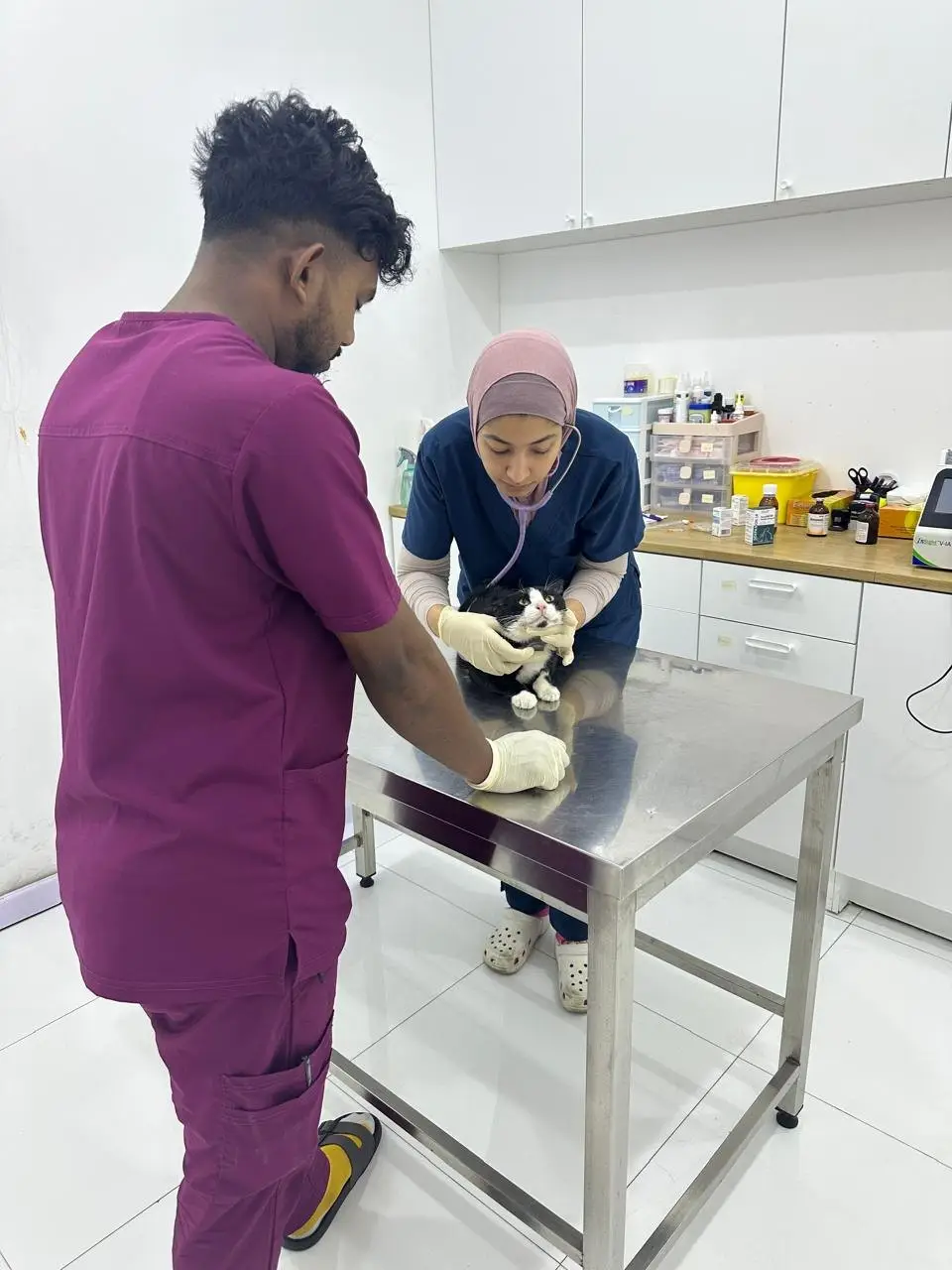
Oxygen comes first. The vet watches her breathing pattern from a distance and listens to her chest for a few seconds. She is then usually left to settle in oxygen before anything else is done. A cat in distress is handled as little as possible. Tests wait until she can cope with them.
Once she is steadier, a quick chest ultrasound or x-ray shows whether there is fluid around the lungs, fluid in the lungs, or a heart that looks enlarged. If fluid is pressing on the lungs, draining it with a needle gives relief within minutes and gives a sample for the laboratory.
Blood tests follow when it is safe. Most of these cats stay in the inpatient ward for at least a night, in oxygen and under observation. For a heart scan by a cardiologist, we refer and will tell you where.
You get a written estimate as soon as the first findings are in. Oxygen and first aid do not wait for it. Consultation and imaging fees are listed on the price page.
What can you do at home afterwards?
Count her sleeping breathing rate once a day and write it down. A rate that climbs over a few days, or stays above 30 while she sleeps, is an early warning worth a call.
Keep her rooms cool, and keep smoke, incense and sprays out of them. Give prescribed medicines at the same time each day, and arrange for someone to give them if you travel.
When to call
Call 055 620 4085 at once if your cat is breathing through her mouth or her sides are heaving. Call if her gums look blue or grey. Do not wait to see whether it settles overnight.
Urgent care at Petflix in Ras Al Khor takes walk-ins until 12 AM. After that, the nurse on the phone will tell you where to go.