

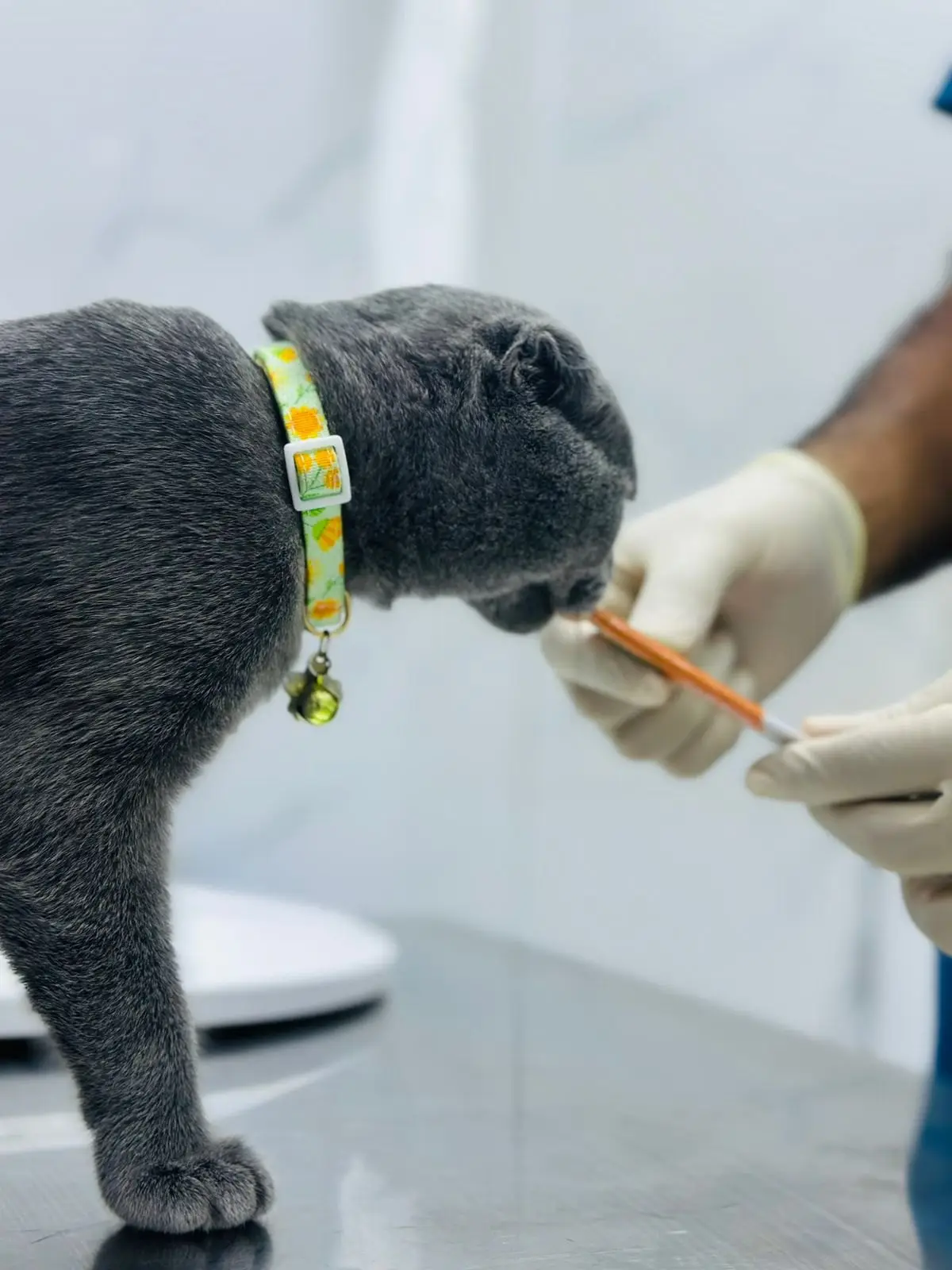
Yes, and the part worth getting right is the handover rather than the booking. Cat boarding with medication works when the dose, the timing and the method come written down, because International Cat Care’s own guidance is that safe restraint matters and that two people are better than one for giving a tablet.
This page covers what to send, what to say, and what to ask. We are open 8 AM to 12 AM every day and the phone is answered 24 hours on 055 620 4085.
Can a cattery give my cat medication?
Cat boarding with medication depends on what the drug is and who is on site, which is the question to ask before you book rather than at the door. The split below is ours, and it is the one that decides whether a boarding kennel or a clinic is the right place.
- A tablet or a liquid once or twice a day is ordinary boarding, provided somebody is trained to give it.
- An injection, insulin included, belongs with a nurse rather than a kennel assistant, in our view.
- Anything that has to be timed to a meal needs the feeding routine written into the chart.
- Fluids under the skin, which some cats with kidney disease need, belong in a clinic.
- A new medication started in the week before you travel needs a vet watching for how she takes it.
Ours runs inside the clinic rather than next to it. The boarding and hospitalisation page says how the cat side is arranged. Standard boarding and the isolation ward have nightly rates on the price list, and a stay with medication is quoted in writing after the pre-travel examination, because it depends on the treatment.
What do I send for cat boarding with medication?
The medicine in its own box, and enough of it, because a missed dose in cat boarding with medication is more often a supply problem than a handling one. Send more than the trip needs in case the flight home moves.
- Every medicine in the original packaging with the label on, rather than loose in a bag.
- Enough for the whole stay plus three extra days.
- The dose and the times written down, even if you have said them on the phone.
- Whatever she normally takes it in, if it goes into food.
- Her usual food, since a diet change and a new place at once is two changes.
- Her vaccination record, with the vaccines in date. If a booster is due, have it at least two weeks before the stay so it has time to work.
- Any recent results from another clinic.
Heat is the local complication. Medication that travels in a car boot or sits by a window loses its reliability, which our page on storing pet medication in Dubai heat explains, so hand it over rather than leaving it in the car.
If you are running low, our pharmacy can dispense the same thing against the prescription so the stay is not interrupted.
Read also: Is cat open mouth breathing an emergency?
How do you give a cat a tablet?
Check with the vet first, then in food if she will take it, and by hand if she will not. It is the part of cat boarding with medication that decides the rest. International Cat Care’s own first step is to check with your vet that the tablet can be given with food at all, because some medication must be given with food and other tablets should be given on an empty stomach. Telling us the method that works at home saves us finding out the hard way.
For food, ICC says that if you hide a tablet in food you should make sure it is completely hidden and only offer a small amount of food initially, then check the tablet has not been left behind or spat out. It is explicit about one mistake, saying not to mix it into the cat’s main meal, as it could deter them from eating and make it hard to see that all the medication has been consumed.
For a clever cat, ICC suggests crushing the tablet where appropriate and mixing it with a liquid treat, or with a little water or oil from a tin of tuna in spring water, which can then be drawn into a syringe without a needle and dribbled gently into the side of the mouth. It adds two cautions we repeat to owners, which are to always check with your vet before crushing since it will not suit all tablets, and to note any handling precautions, because some tablets should not be handled once split or crushed.
For giving it directly, ICC recommends having two people where possible, one to give the tablet and one to hold the cat. Its limit is firm, saying never to heavily restrain your cat, and to let go if they are struggling or trying to bite or scratch, then discuss other options with your veterinary team.
What if my cat refuses her medicine?
Then the formulation changes rather than the fight escalating, and that is a decision for a vet rather than for whoever is holding the cat. In our view it is the main reason cat boarding with medication belongs in a clinic.
ICC’s own route is to go back to the clinic. It says your veterinary team may be able to give the medication or advise on alternative formulations, and suggests a pill giver as an option before hand dosing becomes a struggle.
Stress is the other half of this. The AAFP and ISFM feline-friendly handling guidelines warn that human agitation, rough handling, sudden or erratic movements or loud voices may cause an unexpected or sudden fearful or aggressive reaction. A cat who has had a bad week of tablets is harder to dose on day six than on day one, which is our own observation.
We log every dose and tell you if she is refusing, rather than reporting it when you collect her. We also do not change her dose or her insulin type during a stay without speaking to you first, unless it is an emergency. Both are our own policies rather than a published standard.
How is a boarding cat kept calm?
By letting her hide, which sounds like the opposite of care and is what the guidelines actually say. A cat on cat boarding with medication is handled more than other boarders, so it matters more for her. The AAFP and ISFM guidelines note that cats often respond to confrontation by avoidance or hiding, with fighting only occurring as a last resort, and that allowing cats to feel hidden using items such as towels or carriers may facilitate handling.
- Somewhere to hide inside the pen, which the guidelines name as a handling aid rather than a comfort.
- Her own blanket from home, unwashed, so the pen smells of her.
- Cats housed away from the dogs, which is a layout question to ask any boarding place.
- Handling adapted to the individual cat, which the guidelines say is when handling is most successful.
- The same person doing the doses where the rota allows it.
There is a medical reason to care about this beyond kindness. The guidelines warn that stress may alter results and lead to unnecessary treatments, so a stressed cat is also a harder cat to assess if something changes mid-stay.
Read also: Does matted cat grooming need sedation?
What should I ask before I book?
Six questions, and the answers tell you whether cat boarding with medication is something the place does routinely or something it will try. They are ours rather than anyone’s standard, and they are the ones we would ask about a cattery we did not know.
- Who gives the medication, and are they trained to give the form mine needs.
- Is a vet on site, who is with the cats overnight, and what happens if she is unwell after hours.
- Is each dose recorded, and will I be told if she refuses one.
- Are cats housed away from dogs, and can she hide in her pen.
- What happens if she stops eating, which is the first sign we watch for in a cat.
- Can she have a check before the stay if the medication is new.
That last one matters more for a cat on long-term treatment. If her last bloods were months ago, running them before you travel means the dose is right for the cat she is now, and our same-day results page explains what comes back in the visit.
When should I call while I am away?
You should not have to, because we call you. Leave a number that works abroad and a second contact who can make a decision if you cannot be reached, and tell us before you go which of these you want to hear about immediately.
- She has refused a dose, or two in a row.
- She has not eaten for 24 hours.
- She has vomited, or has diarrhoea.
- She is hiding more than she was on arrival.
- Anything that would need a decision about treatment or cost.
Our page on what is urgent is the same list we work from in the ward.
Frequently asked questions
Short answers to what owners search about cat boarding with medication.
Can a diabetic cat be boarded?
Yes, where a nurse gives the injections and the feeding is timed to them. The risk that makes it a clinic stay is blood sugar falling too low, which shows as weakness, wobbliness, twitching and unusual quietness, and which is most likely when a cat gets her insulin and then does not eat, exactly what a change of surroundings can cause. We check her after every dose for that reason.
Can I crush my cat’s tablet into her food?
Ask the vet first. International Cat Care says some crushed tablets may be mixed with a little water or oil and given by syringe, but to always check with your vet before attempting it since it will not be suitable for all tablets.
What if my cat will not take tablets at all?
There is often another way to give the same drug. ICC says your veterinary team may be able to give the medication or advise on alternative formulations, which is a better answer than a twice-daily struggle.
Will boarding make my cat’s condition worse?
Stress is a real factor and the guidelines treat it as one. The AAFP and ISFM feline-friendly handling guidelines say stress may alter results and lead to unnecessary treatments, which is the argument for a place that lets a cat hide and keeps her away from dogs rather than one that handles her more.
How far ahead should I book?
Book the pre-travel consultation one to two weeks before you fly, because the chart and any bloods have to be arranged rather than just a pen. July, August and the Eid holidays are the weeks our ward space fills first.