


Breathing, kidneys and coat, in that order of urgency. Persian cat health turns on a face shape and an inherited kidney condition, and the Royal Veterinary College’s VetCompass study of the breed found that almost two thirds of Persian cats suffer from at least one health condition.
Most of it is manageable if it is looked for. We are open 8 AM to 12 AM every day and the phone is answered 24 hours on 055 620 4085.
What health issues do Persian cats have most often?
Coat, teeth, nails and eyes, with the breathing and the kidneys underneath them. The RVC study gives the order, naming haircoat disorder as the most common specific disorder at 12.7 percent, then dental disease at 11.3 percent, overgrown nails at 7.2 percent and eye discharge at 5.8 percent.
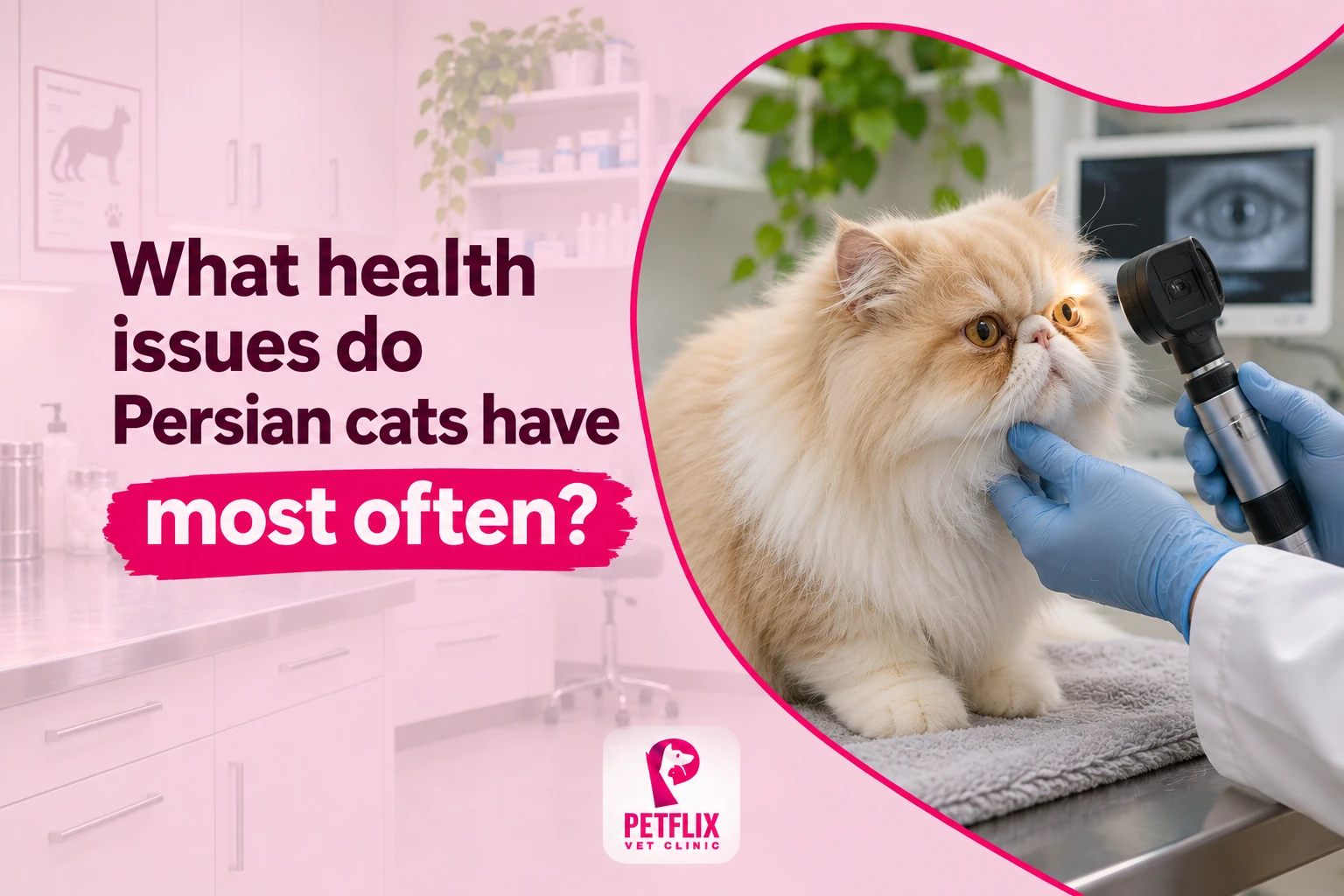
The RVC links three of those four to the same cause. It says the high levels of dental and eye problems seen in Persians are thought to result from the brachycephalic, commonly referred to as flat-faced, shape of these cats’ heads, while the haircoat problems are associated with the thick and long coat which is prone to tangling and matting.
Dental disease at 11.3 percent is worth its own appointment, because crowded and rotated teeth in a shortened jaw trap food where a brush cannot reach. Our dental page covers what a check involves.
The heart belongs on the list too. A cat breathing with an open mouth at rest is never normal whatever the breed, and our page on cat open mouth breathing explains why that is an emergency.
Why does a flat-faced Persian breathe so noisily?
Because the soft tissue did not shrink with the muzzle. International Cat Care says the Persian is bred to have a relatively flat-faced appearance which, when severe, can lead to multiple health problems, and the airway is where that shows first.
The pattern owners describe is consistent. Snoring in sleep, a snuffle at rest, and mouth breathing after play that takes a while to settle. In a dog that would be obvious, and in a cat it gets filed as a breed noise rather than a sign.
Humid months make it worse, which is our observation here rather than a published figure. The same cat who is quiet in January is audible in August, and the difference is the air rather than the cat.
There is a line between noisy and urgent. Open-mouth breathing at rest, blue or grey gums, or a cat who will not settle and is breathing fast belong at the clinic that hour rather than at the next appointment.
Read also: Why is brachycephalic anaesthesia riskier?
Does a doll face Persian have fewer problems?
In the airway and the eyes, usually yes, because a longer muzzle leaves more room for the same soft tissue and lets tears drain the way they were meant to. The traditional or doll face Persian sits at that end of the range.
What does not change is everything below the face. The coat is the same coat, so the matting risk the RVC measured at 12.7 percent applies equally, and the inherited kidney condition in the next section is unrelated to muzzle length.
So a doll face is a different airway, not a different breed health profile. That is a health observation rather than buying advice, and we have nothing to say here about where a kitten should come from.
Why is kidney disease silent in Persian cats?
Because the cysts are there from the start and the blood stays normal for years. Cornell’s Feline Health Center describes polycystic kidney disease as an inherited disorder occurring most frequently in Persian cats, in which small closed fluid-filled sacs develop in the kidney tissue.
Cornell says the cysts tend to multiply over time, eventually overwhelming normal kidney tissue and often leading to potentially fatal kidney failure, and that in an affected cat the cysts are present at birth. So the disease is not something she catches, and nothing about her first years tells you she has it.
Finding it early means looking rather than waiting. Cornell says the cysts, though minuscule, may be diagnosed in kittens as young as six months of age, and its own clinician explains that you cannot feel them and cannot see them on a radiograph, which leaves the ultrasound as the way to a definite answer.
A gene test exists and answers a different question. Cornell notes that you can run a genetic test but it will not tell you how seriously the cat is affected, and that sample goes to an outside laboratory, which our laboratory page explains.
The blood values come later than the scan. Our page on cat kidney values covers what creatinine and SDMA mean, and the scan itself is on our ultrasound page with the fee on the price list. Where the diagnosis is confirmed, our page on chronic kidney disease in cats covers what follows.
How should a Persian coat be cared for at home?
Daily, in short sessions, with a metal comb rather than a brush. International Cat Care says long-haired cats need to be groomed at least daily but only for as long as your cat is comfortable, and that second half is the part most routines get wrong.
Mats start in the same places on nearly every Persian, and knowing them turns a ten-minute job into a two-minute one.
- Behind and under the ears, where the hair is fine and rubs.
- Under the arms and between the hind legs, which International Cat Care says is very thin and extremely sensitive skin.
- The belly, which she keeps away from you.
- Over the hindquarters, which ICC links to a cat who has stopped reaching that far.
Cornell explains why a missed week matters, describing mats as forming when shed hairs tangle with hairs that have not shed, along with dirt, environmental moisture and skin oil, and saying mats should be dealt with promptly when observed. Environmental moisture is the word to notice in a humid city.
Once a mat is tight against the skin it is a clinic job rather than a home one. Our page on matted cat grooming covers when sedation is needed and why scissors cause the injuries we see.
Why does a white Persian cat get tear stains?
Because the tears have nowhere to drain and the evidence shows on pale fur. The RVC recorded eye discharge in 5.8 percent of Persians and links it to the flat-faced head shape, and a white coat simply makes the same overflow visible.
Daily wiping with a clean damp cloth, working outwards from the eye, keeps the skin underneath dry. A damp fold that stays damp is where the skin becomes sore.
A wet eye is not always a drainage problem. Squinting, a half-closed eye, a change in the surface from clear to cloudy, or pawing at it are reasons to be seen rather than wiped, because an ulcer on a prominent eye is both painful and quick.
One unrelated point about white Persians is worth knowing. Deafness is associated with white cats who have blue eyes, so a white cat who does not respond to sound may not be ignoring you.
Read also: What do high cat kidney values mean?
What is the usual lifespan for a Persian cat?
We are not going to give you a number, because the honest answer is that it depends on what has been screened. The RVC’s figure that almost two thirds of Persians have at least one health condition is the useful one, since the conditions are mostly the manageable sort.
Three things shorten it in the Persians we see here, and all three are addressable. Unscreened kidney cysts, heat in a cat who already breathes badly, and dental disease left until she stops eating.
Against that, a Persian scanned early, kept cool, combed daily and given a dental check is a cat whose problems are known rather than discovered.
Which foods suit a Persian cat in Dubai?
Something she can physically pick up, and enough water with it. A flat face and a crowded jaw make small round kibble hard to grip, and a cat who struggles to eat eats less rather than complaining.
Wet food helps with water intake, which matters more in a breed carrying a kidney risk and living in this climate. Salty table food is the thing to keep away from a cat whose kidneys may already be working harder than they look.
Shape and texture are worth asking about rather than brands, and our food plan page covers how a diet is chosen for an individual cat.
When is Persian cat behaviour really pain?
More often than owners assume, and the coat is usually the clue. International Cat Care says decreased grooming may indicate chronic pain from arthritis or dental disease, and points to mats over the lower spine and hindquarters in particular.
- Biting or swiping at the comb in a cat who used to tolerate it.
- Missing the litter tray, especially with a matted rear that makes the tray unpleasant.
- Hiding, or sleeping somewhere new and hard to reach.
- Stopping grooming, which Cornell says is often an indication of a medical problem.
- Eating on one side of the mouth, or dropping food.
One of those is an emergency rather than an appointment. A male cat straining in the tray and producing no urine needs to be seen immediately, and our page on cat urinary blockage explains why.
Is anaesthesia riskier for a Persian cat?
The airway needs a plan, which is not the same as the answer being no. AAHA says brachycephalic dogs and cats are more prone to upper airway obstruction and have been shown to have higher airway-related anaesthetic complication rates compared with nonbrachycephalic breeds.
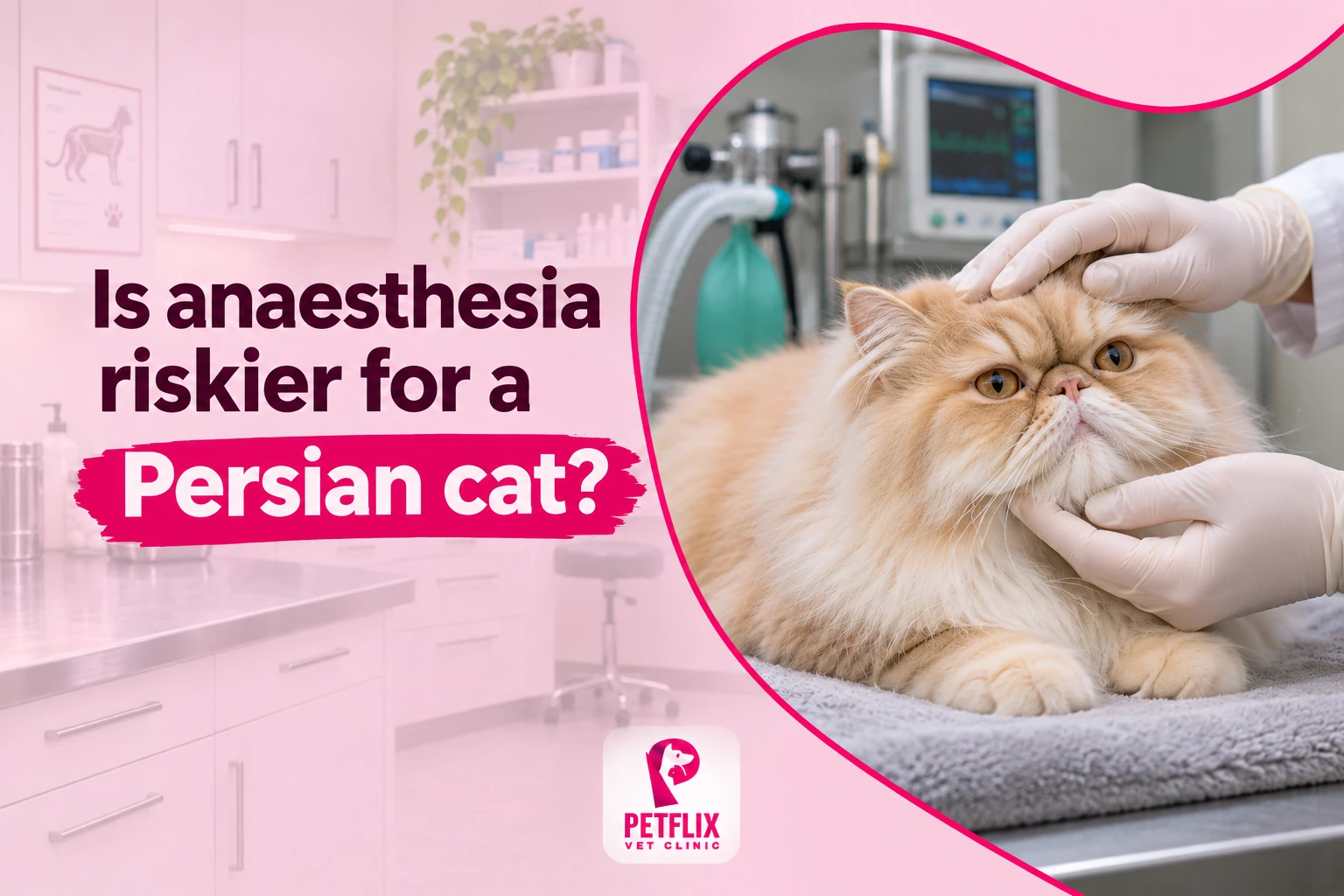
That sentence covers cats explicitly, which owners often miss because the conversation is usually about pugs. Our page on brachycephalic anaesthesia sets out what changes before induction and through recovery.
For a Persian there is a second reason to look before a procedure. The kidney condition above runs silently, so a pre anaesthetic blood test is a conversation we have rather than a formality, and a murmur heard on the morning is a reason to pause rather than press on.
When should I call the clinic?
Call 055 620 4085 the same hour for the first two, and the same day for the rest.
- She is breathing with her mouth open at rest, or her gums look grey or blue.
- He is straining in the tray and producing no urine.
- An eye is half closed, cloudy or being pawed at.
- You can feel hard mats tight against the skin.
- She has stopped grooming, or is eating on one side.
- She is a Persian over six months who has never had a kidney scan.
Our consultation page covers a routine check and the emergency page covers the rest.
Frequently asked questions
Short answers to what owners search about Persian cat health.
Can a Persian cat live 20 years?
Some cats reach it, and we will not promise it for a breed. What the sources support is that the common Persian problems are findable, since Cornell says the kidney cysts can be diagnosed from as young as six months and the RVC’s top four disorders are all things a vet checks at a routine appointment.
What is the healthiest breed of cat?
No source we use ranks breeds that way, so we are not going to. The useful comparison is structural: a cat with a normal muzzle avoids the airway, tear and dental problems the RVC links to a flat face, and a shorter coat avoids the matting it measured at 12.7 percent.
What is a chinchilla Persian cat?
A colour variety rather than a separate breed, with a pale coat tipped in a darker shade. Medically it is a Persian, so the coat routine, the kidney screening and the airway questions on this page all apply unchanged.