

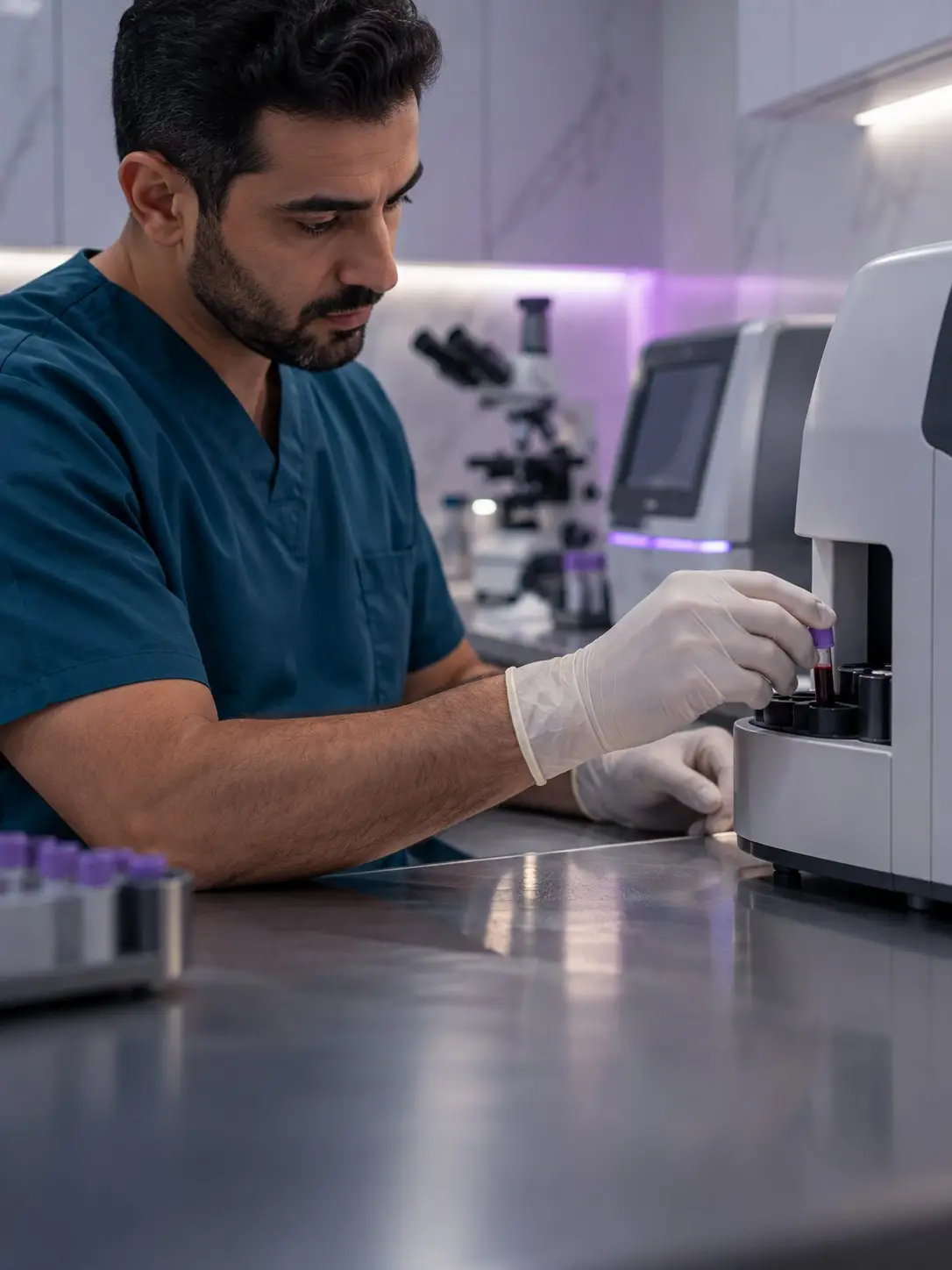
A pre-anaesthetic blood test checks whether your cat or dog can carry oxygen, clot blood, and clear anaesthetic drugs through the liver and kidneys. It takes a small sample from a leg or neck vein, and an in-house lab reports it the same morning, before any sedation is given.
Most results in young animals are normal. The test earns its place on the days it is not, because the plan can still be changed at that point.
The two halves of the test
The sample is split between two machines. One counts cells. The other measures chemicals dissolved in the blood.
Haematology, the cell count
- Red cells. They carry oxygen. A low count is anaemia, and an anaemic animal has less reserve if blood pressure drops or bleeding occurs.
- White cells. A high count points to infection or inflammation somewhere. A very low count means the body may struggle to heal a wound.
- Platelets. These start a clot. A low platelet count is the result surgeons least want to discover halfway through an operation.
Biochemistry, the organ check
- Urea and creatinine. Waste products cleared by the kidneys. High values mean the kidneys are under strain or the animal is dehydrated.
- Liver enzymes. The liver breaks down many anaesthetic and pain drugs. Raised enzymes prompt a closer look at which drugs are used.
- Total protein and albumin. Many drugs travel bound to protein. Low protein changes how strongly a standard amount acts, and it slows healing.
- Glucose. Low sugar is a risk in very young and very small animals after fasting. High sugar can be stress in a cat, or undiagnosed diabetes.
Some panels add electrolytes such as sodium and potassium. These matter most in animals that have been vomiting or not eating.
When a result changes the plan
A result outside the reference range does not always cancel surgery. It leads to one of four decisions.
| Finding | What it may mean | What usually changes |
|---|---|---|
| Mildly raised kidney values | Dehydration or early kidney disease | Fluids into the vein before and during the anaesthetic, a urine test, closer blood pressure monitoring |
| Low platelets | Tick-borne infection, immune disease, or a clumped sample | The count is checked on a blood smear. If it is confirmed low, elective surgery is postponed and the cause is tested |
| Anaemia | Blood loss, parasites, chronic illness | Elective surgery waits. Urgent surgery goes ahead with extra precautions |
| Raised liver enzymes | Many causes, from medication to liver disease | Drug choice is adjusted. Marked rises are investigated first |
| High glucose | Stress or diabetes | Repeat test and urine check before deciding |
For a planned operation such as neutering, postponing costs you a morning. For an emergency such as a womb infection, surgery cannot wait. There the blood test guides how the patient is stabilised and what the team prepares for.
Why hidden problems are more likely in Dubai
Dehydration in the hot months
From May to October, a dog that was walked before the appointment or a cat that drinks little can arrive slightly dry. Dehydration pushes up urea, creatinine and the red cell percentage together. The pattern is recognisable, and fluids correct it. Without the test, that animal would go under anaesthetic with kidneys already short of blood flow.
Tick-borne infections in dogs
Ticks are active in the UAE for much of the year, and some carry infections that lower platelets. A dog can look well and still have a platelet count too low for safe surgery. This is one of the more common reasons a routine neutering is moved here.
Imported breeds with inherited disease
Persians, Exotic Shorthairs and British Shorthairs can carry polycystic kidney disease. Kidney values may already be creeping up in a cat of five or six that seems healthy at home.
Rescued cats with no history
Many households here have taken in a community cat. Age is a guess, past illness is unknown, and chronic infection or anaemia is more common than in a home-bred kitten. A blood test stands in for the missing history.
Which animals should have it
We advise it for every cat and dog over seven, for any animal that has been unwell, and for flat-faced breeds. It is also sensible for any patient on long-term medication and for every emergency operation.
For a healthy one-year-old having a short procedure, the vet will explain that the chance of finding something is small. You then decide. If you decline, that is recorded, and the physical examination on the morning still goes ahead.
Laboratory fees are on our price list, and the panel appears as its own line on the written estimate you receive before the procedure.
How the sample is taken
Blood comes from a vein in the front leg or the neck. A small patch of fur is clipped. Most animals need only gentle holding by a nurse. The needle is in for a few seconds.
Your pet has usually been fasted for the anaesthetic anyway, which suits the test. Food in the previous few hours can cloud the sample and shift glucose and fat readings.
The sample is run in our in-house laboratory, so the vet reads it before the first injection is drawn up. If the blood was taken at a separate visit within the previous few weeks and your pet has been well since, it normally does not need repeating.
What the test cannot tell you
A normal panel does not make an anaesthetic risk-free. It does not examine the heart or the lungs. A murmur, a cough or poor exercise tolerance calls for a chest x-ray or a heart scan instead. It also cannot predict a rare drug reaction.
It removes one group of avoidable surprises. The rest is covered by the examination, the monitoring and the person watching your pet from induction until he is awake. Our surgery page explains how that day runs.
When to call
Call 055 620 4085 before the operation day if your pet is drinking more than usual, has lost weight, has vomited in the past week, or has had ticks. Tell us about every medicine and supplement he takes. Any of these may mean the blood is taken a few days early.
The phone is answered 24 hours, and the clinic is open 8 AM to 12 AM every day.