

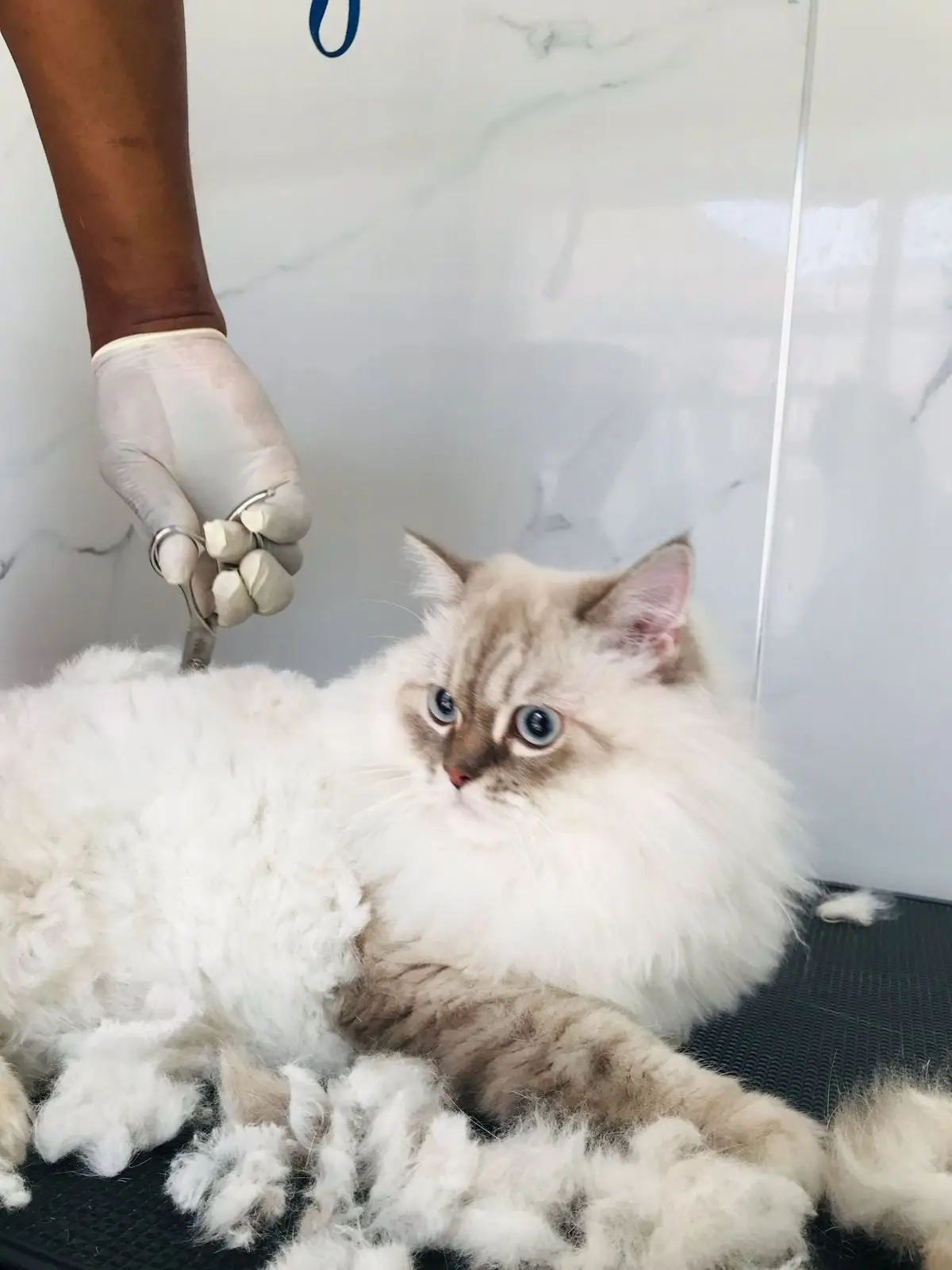
It depends on how far the coat has gone. International Cat Care says a professional cat groomer may be able to groom mats out by hand, but that in many cases severe mats will need to be shaved off by your veterinary team, and that this often requires sedation or a general anaesthetic. So light tangles are a grooming job and matted cat grooming against the skin is a clinic job.
Do not reach for scissors meanwhile, because International Cat Care says to always tease mats out rather than cut them away. We groom inside the clinic, open 8 AM to 12 AM every day, on 055 620 4085.
What is the difference between a mat and a tangle?
A tangle sits in the coat and a mat sits against the skin, and the difference is what decides whether this becomes a matted cat grooming job. Cornell’s Feline Health Center describes how one becomes the other, saying mats usually form when shed hairs become tangled with hairs that have not shed, along with dirt, environmental moisture, excessive oil from the skin’s oil glands and, in some cases, urine or faeces.
That difference decides what you can safely do. A loose tangle you can still slide a comb under is worth teasing apart gently, a few hairs at a time, which is what International Cat Care means by teasing rather than cutting. A mat you cannot get a comb beneath, or that moves the skin when you lift it, is a job for the clinic.
Check the places skin rubs on skin first, which is behind the ears, in the armpits, along the belly, inside the back legs and under the tail. International Cat Care warns to take extra care under the armpits and between the hind legs, because the skin there is very thin and extremely sensitive.
Why do long-haired cats mat so fast in Dubai?
Because a dense undercoat and a Dubai summer work against each other, which is what we see in the clinic. International Cat Care describes the Persian as having a very thick undercoat, and the same goes for the other long-haired breeds we groom here.
Persians have it worst, and there is a number for it. A Royal Veterinary College VetCompass study of Persian cats found haircoat disorder to be the single most common specific problem in the breed at 12.7 percent, ahead of dental disease, overgrown nails and eye discharge. International Cat Care adds that many Persians cannot keep their coat free of mats on their own.
Age and shape matter as much as breed. Cornell says older cats groom themselves less effectively than younger ones, sometimes resulting in hair matting, skin odour and inflammation, and names restricted access to parts of the body, as in an overweight cat who cannot reach her hind end.
The local climate is our own observation rather than a published finding. An indoor cat here moves between dry, chilled rooms and a humid balcony from June to September, and a coat that was manageable in March can be felted by August.
Is matted fur painful for a cat?
Yes, and International Cat Care puts it plainly, that if your cat has become matted it can be very uncomfortable. A tight mat pulls on the skin with every movement, which is why a matted cat often resents being touched at all by the time you book.
Underneath, the skin stays damp and airless. Cornell warns that mats may predispose cats to skin infections and external parasites such as fleas, and says they should be dealt with promptly when observed.
- Skin that turns red, thin and sore under the mat, and can break open.
- Bacterial and yeast infections growing in the damp air trapped against the skin.
- Fleas, flea dirt and small wounds hidden from view until the coat comes off.
- Mats under the tail that trap urine and faeces and scald the skin beneath.
- Mats between the legs tight enough to change how she walks.
Two MSD Veterinary Manual pages show where that leads. MSD says matted coats contaminated with faeces attract flies, and that lice are most often seen on older, long-haired cats who are no longer able to groom themselves. MSD also describes clipping excessive hair in cats with a deep skin infection, so that the coat stops trapping debris and bacteria.
Can you cut matted cat fur with scissors?
No, and it is one of the commonest ways we see owners hurt a cat they are trying to help. International Cat Care says to always tease mats out rather than trying to cut them away with scissors, because it is very easy to damage the skin that way.
The reason is that cat skin is loose. When you lift a mat to get scissors underneath it, skin can come up inside the mat where you cannot see or feel it, and the blades close on the skin rather than the hair. We see the result of that in the clinic, a clean cut that can run several centimetres and bleeds so little that an owner finds it a day later.
Clipping is safer but not risk-free either, which is the other argument for matted cat grooming being done at a clinic. Cornell cautions that it is common for the skin to be damaged during the shaving process, and that this may predispose a cat to skin infections, so it is better done where a vet can treat what turns up underneath.
When does matted cat grooming need sedation?
When the mats are tight to the skin or the cat cannot cope with being handled. Cornell says that in rare, extremely advanced cases of matting, cats may need to be sedated or even anaesthetised to remove mats safely and efficiently, and International Cat Care describes sedation or general anaesthetic as what severe mats often require.
The two sit either side of one line. An ordinary tangle is combed out awake, and matted cat grooming tight against the skin is not, which is the judgement the vet makes when she sees the coat.
- The coat has joined into sheets, or mats sit tight against the skin over large areas.
- Mats are under the armpits or between the hind legs, where International Cat Care says the skin is very thin and extremely sensitive.
- The cat is clearly in pain when the coat is touched.
- She bites, scratches or panics when restrained, or has injured someone at a previous groom.
- The skin under the mats is already sore or infected.
The timing of that decision matters more than owners expect. The AAFP and ISFM feline-friendly handling guidelines say it is always better to use chemical restraint pre-emptively, because once the cat is agitated it becomes less effective or reliable. The same guidelines say some cats get worse with breaks and repeated attempts at handling, and that those patients should be sedated or anaesthetised.
The reason it is kinder is in the guidelines too, which state that chemical restraint may increase safety and reduce stress for the cat, the client and the veterinary team.
What are the risks of sedating a cat?
Small, but real, and worth hearing before you agree to it. A UK referral hospital, Davies Veterinary Specialists, sets them out plainly, saying that as with any medical procedure there is a small risk when an animal is given either a sedative or an anaesthetic agent.
It splits them by severity. The minor ones it names are a prolonged recovery with excessive sleepiness for a period, or a temporary drop in body temperature. The serious ones it names are regurgitation of stomach contents and the pneumonia that can follow, anaphylactic reactions, or death, while adding that although these risks can never be eliminated they can be minimised.
Age shifts the odds. Davies says studies have shown that anaesthesia of cats and dogs older than 12 years does carry a slightly higher risk than in younger patients. For an older cat or one with a known illness, the vet may advise blood work beforehand, which Davies describes as the kind of extra test suggested when a pre-anaesthetic assessment picks something up. We run it in our in-house laboratory during the same visit.
Read also: What a pre-anaesthetic blood test checks in cats and dogs
Fasting is individual rather than a fixed rule. Davies says most animals need a period of fasting before an anaesthetic and that you will be told if that is not the case for your pet, so the clinic gives you the hours when you book rather than you guessing. Flat-faced breeds need their own conversation about the airway before any sedation.
Read also: Anaesthesia in flat-faced dogs and cats
How do you groom a cat that hates being brushed?
Slowly, briefly, and never by force. International Cat Care is explicit that your cat should never be forcibly groomed or stroked without the option to escape if she is finding the experience stressful, and that if she shows signs of stress you should stop and see whether she will tolerate it another day.
Watch for the early signs rather than the bite. The same guidelines say that recognising these signs early allows measures to be taken before escalation to full fear aggression, and that if the cat begins to show fear you should slow down or take breaks from handling. They also warn that rough handling, sudden movements or loud voices can trigger a sudden fearful or aggressive reaction.
Reward rather than correct. International Cat Care advises rewarding relaxed behaviour with praise and food treats throughout the session, and Cornell warns that any type of physical punishment can increase a cat’s fear or anxiety and worsen aggression. A cat already booked in for matted cat grooming has usually had a few bad brushing sessions behind her, so the handling matters as much as the clippers.
Why has my cat stopped grooming herself?
It is the question behind the grooming appointments we see, and it is a medical one. Cornell says an unkempt appearance resulting from failure to groom is often an indication of a medical problem, and that cats with this appearance should be seen by a veterinarian.
Pain is one of the first things to rule out. International Cat Care points to mats over the lower spine and hindquarters, saying decreased grooming may indicate chronic pain from arthritis or dental disease, and it lists a matted, scruffy coat among the signs of arthritis in cats. Cornell makes the same link to aggression, noting that cats in pain may act aggressively to avoid touch.
There are other causes to rule out. Cornell lists an unkempt, matted or greasy coat among the signs of an overactive thyroid, and says the first step in managing an aggressive cat is to make sure there is no medical reason for the behaviour.
So a sudden change in how she grooms is a reason for a consultation, a look at her teeth and, in an older cat, a check for joint pain, rather than a matted cat grooming booking on its own.
How do you stop the mats coming back?
Daily, and in short sessions, which is the only reliable way to keep ahead of the mats. International Cat Care says long-haired cats need to be groomed at least daily, but only for as long as your cat is comfortable, and that second half is the part most routines get wrong.
- Comb every day rather than for an hour once a month, using a comb that reaches the skin instead of a brush that skims the top.
- Start with the areas she enjoys and finish with a treat, which is the reward pattern International Cat Care describes.
- Run your fingers through the armpits, belly and behind the ears weekly to catch a mat while it is still a tangle.
- Book a professional groom before the coat gets away from you, which we suggest more often through the humid months.
- Ask about a shorter trim for summer if daily combing is not realistic in your household.
Basic and full grooming prices for cats are listed on the price page, and matted cat grooming adds sedation, a pre-sedation blood test and any skin treatment on top. You get a written estimate after the vet has seen the coat and before anything is given.
When should I call about a matted cat?
Call 055 620 4085 if you can feel hard lumps of hair against the skin, or if your cat cries or bites when you comb her. Call if there is a smell or a damp patch under a mat, and call the same day if you have cut her skin while trimming.
Say in the call that she is matted or hard to handle, so the grooming appointment is booked as matted cat grooming, with a vet check and enough time in the diary.
Frequently asked questions
Short answers to the questions owners search for before booking matted cat grooming.
Will my cat’s matted fur grow out on its own?
No, it gets harder to deal with. Cornell describes a mat as shed hair binding with hair that has not shed, along with moisture and skin oil, and says mats should be dealt with promptly when observed, which is the opposite of waiting for one to fall out.
Is shaving a cat cruel?
In our view leaving a painful mat in place is the crueller option. International Cat Care says that in many cases severe mats need shaving off by the veterinary team, and warns that a severely matted cat ends up with fur only on the tail, head and lower legs until it grows back, which is what the result looks like.
Can a groomer sedate my cat?
Sedation is a veterinary procedure, so it needs a vet who has examined your cat first, not a salon. That is the reason we groom difficult and matted coats inside the clinic, with a nurse watching her through the procedure and recovery.
How often should a Persian be groomed?
International Cat Care says long-haired cats need grooming at least daily, for as long as the cat stays comfortable. Given that the Royal Veterinary College found haircoat disorder to be the commonest specific problem in Persians, daily is the floor rather than the target.