

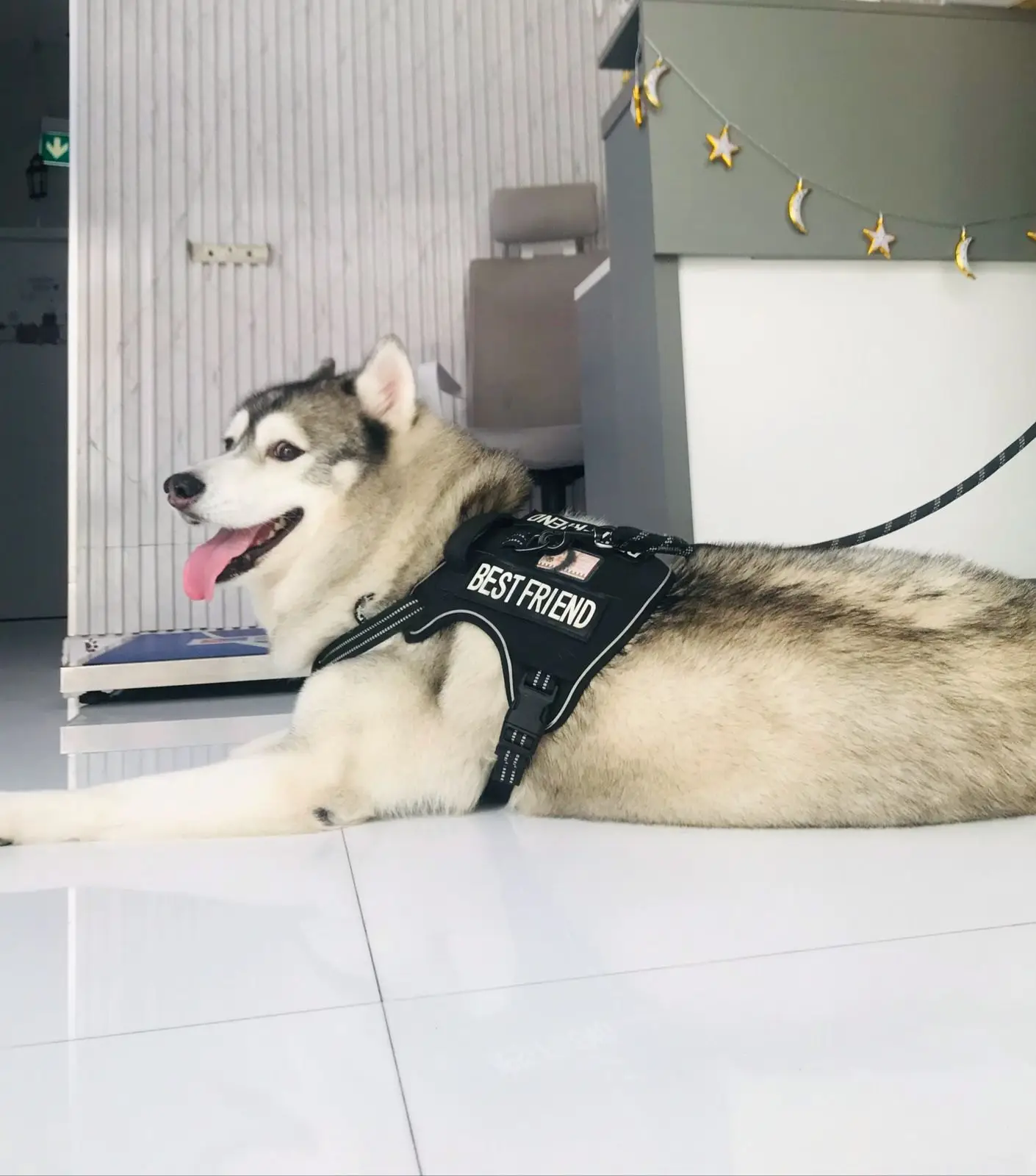
Retching with nothing coming up, and a dog who will not settle. Those are the first signs of bloat in dogs, and the American College of Veterinary Surgeons describes the condition as rapidly progressive and life-threatening, requiring immediate medical attention. The swelling is not always visible, so go by the retching.
This is a drive now, not a morning appointment. Call 055 620 4085, answered 24 hours, and we are open 8 AM to 12 AM. After midnight the clinic is closed and the nurse will direct you to the nearest hospital that is open, so go there rather than to us.
What are the first signs of bloat in dogs?
Pain before swelling, which is the part we see missed. ACVS says the initial signs are often associated with abdominal pain, and lists what that looks like from the outside.
- An anxious look, or the dog looking round at his own abdomen.
- Standing and stretching, which ACVS names specifically.
- Drooling more than usual.
- A distending abdomen, meaning one that is visibly getting bigger.
- Retching without producing anything, which is the sign that separates this from ordinary vomiting.
What comes next is worse and faster. ACVS says that as the disease progresses the dog may begin to pant, have a bloated belly, or be weak and collapse, and that on examination these dogs often have raised heart and breathing rates with poor pulse quality.
The retching is the one to act on. A dog who vomits brings something up, and a dog with bloat tries and brings nothing, because what is blocking the way out is the stomach’s own position.
Do not wait for the belly to look wrong. In a heavy-coated husky or a deep-chested shepherd the stomach can sit up under the ribs, which is what we see in the clinic, so unproductive retching in a large dog is an emergency until a vet says otherwise.
What actually happens in a dog’s stomach?
Gas and food distend it, and then it can turn. ACVS explains that the presence of food and gas causes the stomach to significantly dilate and expand, and that it can become dilated enough to rotate on itself, which is termed gastric volvulus.
The damage is not only to the stomach. ACVS lists the consequences of that distension as prevention of adequate blood return to the heart from the abdomen, loss of blood flow to the lining of the stomach, rupture of the stomach wall, and pressure on the diaphragm that stops the lungs expanding properly.
Once it rotates, the blood supply is the problem too. ACVS says the rotation can lead to blockage in the blood supply to the spleen and the stomach.
It puts the organ damage earlier than the twist, though. ACVS says diminished respiration and cardiac output throughout the course of the disease lead to poor oxygen delivery and then to cell death in the liver, kidneys and other vital organs, with abnormal heart rhythms commonly seen because of it. So a distended stomach that has not turned is still an emergency.
Read also: Does my pet need an x ray or ultrasound?
Which dogs are most at risk of bloat?
Deep-chested dogs, and the ones fed once a day. ACVS is careful to say nearly all breeds of dogs have been reported to have had this condition, so the list below is about odds rather than about safety.
- A deep chest, which ACVS defines as an increased thoracic height to width ratio.
- Being fed a single large meal once daily, which ACVS names as an association.
- Being older, which is also on ACVS’s list.
- Being related to other dogs that have had the condition.
- Great Danes, Weimaraners, St Bernards, Irish setters and Gordon setters, which ACVS names as commonly seen breeds.
A further group sits on ACVS’s suggested list rather than its confirmed one. It says elevated feeding, dogs that have previously had a spleen removed, large or giant breeds and stress may result in an increased incidence, and it cites a 2006 study that found dry foods listing oils such as sunflower oil or animal fat among the first four label ingredients predispose a high-risk dog to the condition.
We see plenty of large breeds here, and the feeding routine is the part you control, which our food plan page covers.
Why does the Dubai routine raise the risk?
Because the heat pushes the walk and the meal into the same short window, which is our own reading of the bloat in dogs we see here rather than a published finding. For much of the year it is too hot to walk a large dog in daylight, so the exercise lands just after sunset.
That is the same window in which the household gets home and feeds him. A hungry husky empties his bowl in under a minute, drinks a full bowl of water and goes straight out for a run, and ACVS names rapid ingestion of large meals as an association. Ramadan shifts the evening later again, with dogs fed after iftar and walked near midnight.
How is bloat in dogs diagnosed?
With a picture, and fast, because the x-ray is what separates a distended stomach from a rotated one. ACVS says abdominal x-rays are used to confirm a diagnosis, and our digital x-ray is in the building rather than booked for another day.
Blood work runs alongside it. ACVS says most veterinarians will recommend initial blood work including a complete blood count, serum chemistry, blood electrolytes and a urinalysis, which allow the metabolic disturbances to be assessed and let the vet rule out diseases that mimic the signs. Those run in our laboratory during the same visit.
ACVS also names an ECG, used to evaluate the presence of cardiac arrhythmias, which it says are commonly seen later in the disease course. That is part of why the assessment happens quickly rather than in stages.
What is the treatment for bloat in dogs?
Stabilisation first, then surgery, and ACVS says surgery is indicated once the diagnosis has been established. The order matters, because a dog in this state cannot safely go straight to an anaesthetic.
ACVS says most pets will require pre-operative stabilisation such as intravenous fluids and oxygen therapy prior to general anaesthesia, and that gastric decompression often follows. The surgery it describes involves full exploration of the abdomen and de-rotation of the stomach, with the viability of the stomach wall, the spleen and other organs assessed, and removal of part of the stomach wall or the spleen if necessary.
The last step is what stops it happening again. ACVS says that once the stomach is back in its normal position it is permanently affixed to the abdominal wall, a gastropexy, and that the purpose is to prevent rotation if the stomach dilates again.
The week after is a hospital week. ACVS says most pets will be hospitalised and given supportive medication for several days after surgery, with cardiac electrical activity monitored, and that while many develop a transient heart rhythm problem most need no additional treatment and it resolves with time. Our surgery page sets out how an abdominal procedure runs here.
Read also: Does my pet need a pre anaesthetic blood test?
Can a dog survive bloat?
Most treated dogs do. ACVS reports that mortality rates for bloat in dogs, where the stomach has also rotated, have been reported to be approximately 15 percent, and in our view the timing of the drive is the biggest lever an owner holds.
Four things make that figure worse, and ACVS names them. They are clinical signs present for more than six hours, cardiac arrhythmias before surgery, needing part of the stomach removed because its blood supply was lost, and needing the spleen removed.
That six-hour figure is not a deadline to aim at. It is the point by which the odds have already moved against the dog, and ACVS says stabilisation and surgery are best performed early in the course of the disease since death rates increase with its severity, with time since onset associated with higher complication and mortality rates. An hour spent deciding is an hour spent on the wrong side of that.
Can bloat in dogs be prevented?
Partly, and there is a surgical option for high-risk dogs that owners of large breeds should know exists. ACVS says prophylactic gastropexy is currently being recommended by many veterinary surgeons for breeds at risk, or for dogs with relatives who have had the condition, and that it can often be done at the same time as sterilisation surgery.
Feeding is the other half. ACVS’s own long-term advice after surgery is multiple small meals, two or three per day, rather than a single large meal, which is the same association it lists as a risk factor in the first place.
The rest of the routine is ours rather than ACVS’s, and it follows from the rapid-ingestion association it does name. None of it prevents bloat in dogs outright.
- Keep about an hour of rest before a meal, and one to two hours after it.
- Through the summer, walk first and feed later rather than the other way round.
- Slow a fast eater with a slow-feeder bowl, or by scattering the kibble on the floor.
- Offer water through the day so he does not drink a whole bowl at once after exercise.
- Feed dogs separately if they compete over food, since competition speeds them up.
One honest limit. ACVS says that after a gastropexy some pets may still experience some degree of gastric dilatation without volvulus, typically after a very large meal, and that while the gastropexy will not prevent the stomach from expanding it should serve to prevent the life-threatening rotation.
When should I call the vet about bloat?
Call 055 620 4085 and start driving if any of the following is true, rather than waiting to see whether it settles. ACVS’s instruction is that a dog showing these signs should be evaluated by a veterinarian immediately.
- He is retching or heaving and nothing comes up.
- His belly looks bigger or feels tight, particularly behind the ribs.
- He is pacing, standing and stretching, or cannot lie down.
- He is drooling and looking round at his own side.
- He is panting, weak, or has collapsed.
On the phone, say large dog, retching, swollen belly. Those words move you to the front.
Do not offer food or water on the way in, because what happens next may be an anaesthetic, and do not try to make him vomit, because he cannot. You get a written estimate before surgery starts, and stabilising the dog does not wait for the paperwork. Our emergency page says what happens when you arrive, and fees are on the price list.
Frequently asked questions
Short answers to what owners search about bloat in dogs when it is happening.
How quickly does bloat kill a dog?
Fast enough that hours matter. ACVS calls it rapidly progressive and life-threatening, and names clinical signs present for more than six hours as a factor shown to increase the mortality rate. There is no safe interval to wait and watch.
Can bloat in dogs resolve on its own?
Not once the stomach has rotated, which is the part an x-ray shows and an owner cannot. ACVS says surgery is indicated if the diagnosis of gastric dilatation volvulus has been established, so the question is answered by the picture rather than by waiting.
Does raising the food bowl prevent bloat?
No, and ACVS points the other way. It says elevated feeding has been suggested as something that may result in an increased incidence of this condition, so a raised bowl is not a precaution to rely on.
Can small dogs get bloat too?
ACVS says nearly all breeds of dogs have been reported to have had gastric dilatation with or without volvulus, so size reduces the odds rather than removing them. Its page describes the condition in dogs, and a cat in distress is a different set of signs to learn.
Should I ask for a preventive gastropexy?
It is a fair question for a deep-chested breed. ACVS says many veterinary surgeons now recommend prophylactic gastropexy for at-risk breeds or dogs with affected relatives, and that it can often be combined with neutering, which means one anaesthetic rather than two.