

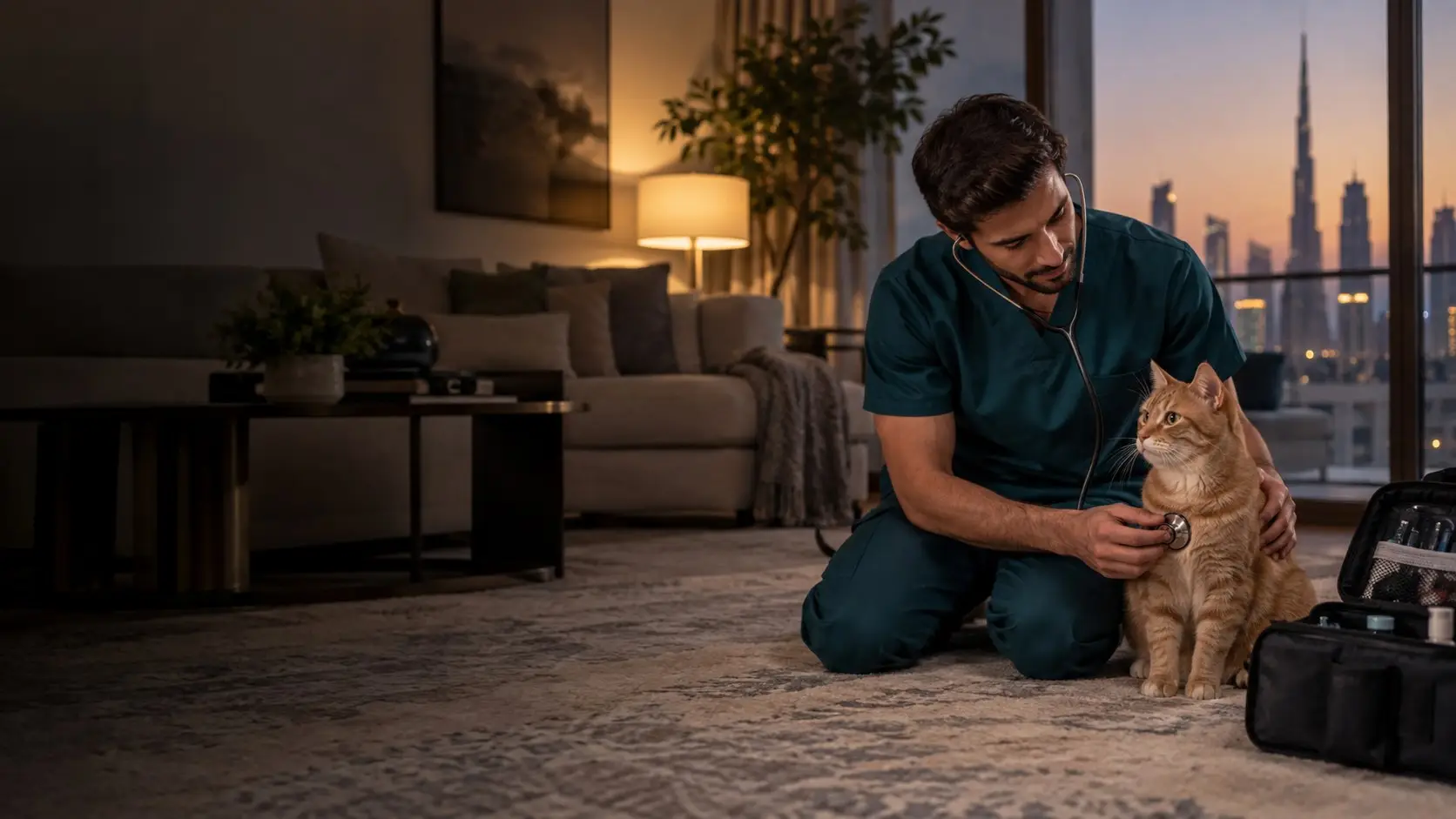
A vet at home can examine your cat or dog, vaccinate, take blood and urine samples, check a senior animal and recheck a healing wound. A vet at home cannot x-ray, scan, give an anaesthetic, operate, or treat an emergency. Knowing which side your problem falls on saves you a wasted visit.
Home visits are booked by phone or WhatsApp on 055 620 4085. The clinic is open 8 AM to 12 AM every day and the phone is answered 24 hours.
What works well at home?
The physical examination
A full nose-to-tail exam needs hands, a stethoscope, a thermometer, a light and scales. All of that fits in a bag. The vet listens to the heart and lungs, feels the belly, checks teeth, ears, eyes, skin, joints and lymph nodes, and weighs your animal.
At home the vet also sees things a clinic never shows. Where the litter trays are. What is in the food bowl. How an old dog manages the stairs or a slippery tile floor. Whether a balcony door or window is cat-proofed.
Vaccinations
Annual vaccines for healthy adult cats and dogs are well suited to home. The vet examines first, vaccinates, and stamps the vaccination book. Vaccines travel in a cool box and come out only when the vet is ready to inject.
One limit applies. The vet stays for a short while after the injection to watch for a reaction. Serious reactions are rare, but an animal with a history of vaccine reactions should be vaccinated at the clinic.
Multi-cat households
Taking four cats to a clinic means four carriers, two trips in the lift and a car that has to stay cold. It also means four stressed cats who smell of the clinic and hiss at each other for a day afterwards. One home visit covers all of them in under an hour, and nobody has to be caught twice.
Senior check-ups
Older cats with arthritis or kidney disease, and large old dogs who cannot climb into a car, are the animals that most need regular checks and most often miss them. At home the vet can examine and weigh an old animal where he is calm, and take blood and urine.
The samples go back to the in-house laboratory at the clinic. Results are sent to you, with a call if anything needs action.
Anxious and carrier-phobic animals
Some cats have to be chased under a bed for every visit. Some dogs shake from the car park onwards. Fear changes heart rate, breathing, blood pressure and blood glucose, which makes clinic readings harder to interpret. Many of these animals allow a calm exam on their own sofa.
Smaller jobs
- Nail trims, and anal gland checks in dogs.
- Wound and stitch checks after surgery, and stitch removal.
- Injections that are part of an ongoing course.
- Teaching you to give tablets, insulin or fluids under the skin.
- A quality-of-life discussion for an animal near the end of life.
What has to be done at the clinic?
These limits are about equipment and safety. No portable kit gets around them.
- X-rays and ultrasound. The machines, the shielding and the staff to position the animal are at the clinic. A limp that needs an image, a swollen belly or a suspected swallowed object means a trip to x-ray and ultrasound.
- Anything under anaesthetic or sedation. That includes neutering, dental cleaning, wound stitching and lump removal. Safe anaesthesia needs oxygen, monitoring equipment and a nurse watching throughout.
- Drips and hospital care. An animal that is dehydrated, not eating, or needs repeated injections through the day belongs in the inpatient ward.
- Infectious disease. A puppy with suspected parvovirus or a cat with suspected panleukopenia needs isolation facilities and testing on site.
- Anything urgent. See the next section.
A home visit often ends with a recommendation to come in for one of these. That is a normal outcome. The exam at home tells you the trip is needed, and the vet who saw your animal has already written up the findings.
Why is an emergency not a home visit?
A home visit is a booked appointment with travel time. An animal who cannot breathe, is bleeding, is having seizures, cannot pass urine, or has collapsed needs oxygen, a drip, imaging and sometimes surgery within minutes. None of that is in a car boot.
Waiting an hour for a vet to reach you, and then being told to drive to the clinic anyway, costs the hour. If you are unsure, phone. The nurse will tell you whether it is a home visit problem or whether you should come to urgent care at the clinic.
What makes home visits different in Dubai?
From May to October the hardest part of a vet visit is often the trip itself. Picture a cat in a carrier, an open car park in the midday sun and a taxi with weak air conditioning. For a flat-faced Persian or an elderly cat that is a real risk.
Many owners in International City, Silicon Oasis and Dubai Creek Harbour do not drive, and not every taxi will take a dog.
A few practical points for tower living help the visit run on time.
- Register the vet as a visitor with building security ahead of time, and say where visitor parking is.
- Send a location pin with the building name, tower letter and flat number.
- Shut cats in one small room an hour beforehand. A bathroom is ideal. A cat under a king-size bed can use up half the visit.
- Keep dogs on a lead when the door opens.
- Have the vaccination book and any current medicines on the table.
Evening slots suit most working households. During Ramadan, visits after iftar are often the easiest time for everyone.
What does it cost?
The home visit fee depends on your area, and you get it in writing on WhatsApp before you confirm. Vaccines, tests and medicines are charged as they would be at the clinic. Those figures are on the price page.
When to call
Call or WhatsApp 055 620 4085 to book a home visit for an exam, vaccines, a senior check or a multi-cat household. Tell us how many animals, their ages and what worries you. Details of areas and timing are on the home visit service page.
If your animal is struggling to breathe, bleeding, seizing or collapsed, do not book a visit. Call, and come in.